
Why garden lighting cannot be improvised
A garden exposes fixtures to the elements, significant thermal variation, and permanent humidity. Choosing an insufficient IP rating, cabling not suited to burial, or an undersized power supply leads to rapid failures, electrical hazards, and remediation costs far exceeding those of a correctly designed installation from the outset.
Beyond the technical side, the most common pitfall is too much light. Excessive illuminance destroys the mystery of the nocturnal garden, creates light pollution for neighbours, and wastes energy needlessly. Our approach targets the right balance, with adjustable sources, dimming adapted to the time of day and use, and chromatic coherence across the entire plot.
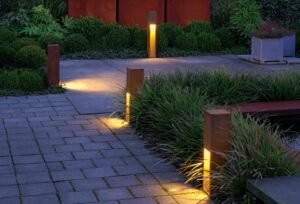
IP ratings and installation requirements
- IP65: jet-water protection, suitable for plant spotlights, façade wall lights, and path bollards
- IP67: temporary immersion (30 min, 1 m), for in-ground recessed fittings in highly exposed areas
- IP68: permanent immersion, mandatory for pond and water-feature spotlights
- IK08–IK10: impact resistance, recommended for bollards and floodlights in circulation areas
- Buried cable: ICTA conduit or U1000R2V cable depending on depth and Belgian local regulations
Garden zones and recommended lighting approach
| Zone | Primary objective | Colour temperature | Recommended source type | Min. IP rating |
|---|---|---|---|---|
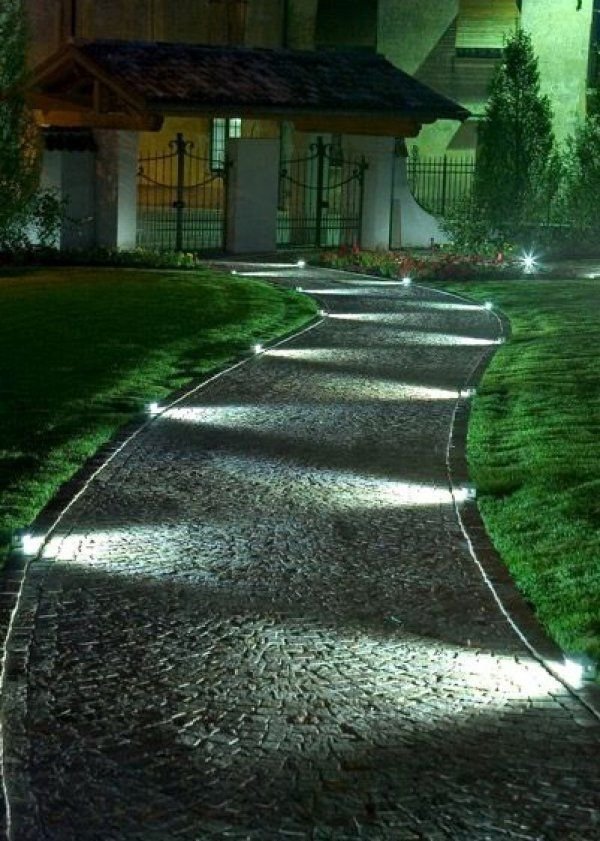
| Entrance driveway | Wayfinding and safety | 3000 K | 40–60 cm bollards, in-ground recessed | IP65 |
| Covered terrace | Atmosphere, conviviality | 2700–3000 K | Adjustable spotlights, LED string lights | IP44–IP65 |
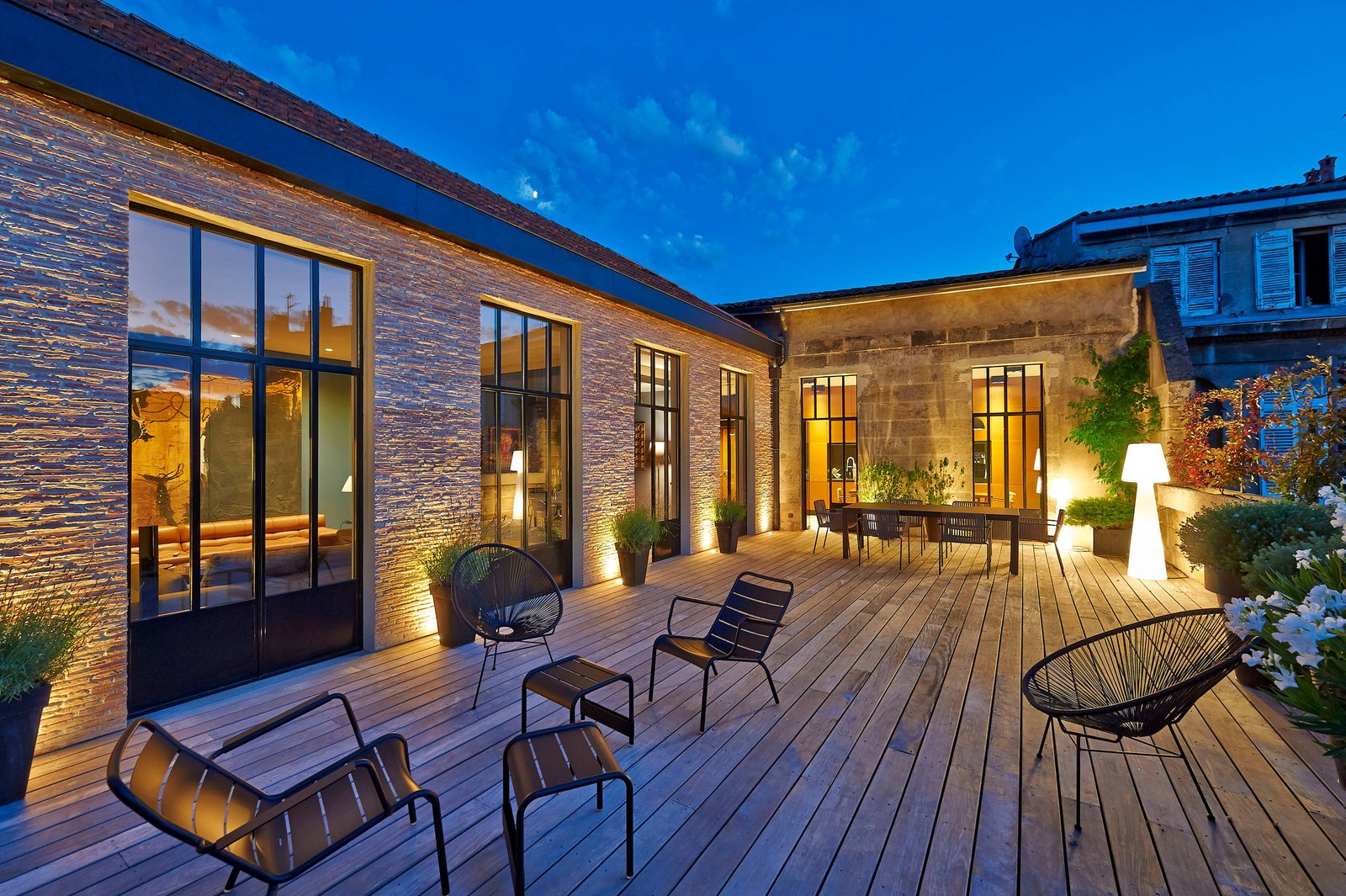
| Open terrace | Atmosphere and rain resistance | 2700–3000 K | In-ground recessed spots, low wall lights | IP65 |
| Trees and planting | Staging, dramatisation | 2700–3000 K | Adjustable spotlights (spike or recessed) | IP65 |
| Façade and gate | Security and aesthetics | 3000–4000 K | Wall lights, asymmetric floodlights | IP65 |
| Pond and water feature | Visual effect, enhancement | 2700 K or RGB | Submersible waterproof spotlights | IP68 |
| Fence and boundary | Perimeter, discreet | 3000 K | Recessed LED strip, low bollards | IP65 |
Colour temperatures outdoors — choosing the right atmosphere
Gardens generally call for warm light (2700 K to 3000 K), which naturally extends the interior atmosphere outwards and flatters green planting and natural materials such as stone, timber, and terracotta. Cool tones (4000 K and above) should be reserved for strictly functional areas, such as a secure access point, a garage, or a utility room.
Effects and contrast
- Grazing: a steeply angled spotlight directed along a stone façade, clipped hedge, or planted wall, to reveal texture
- Uplighting: spotlight aimed upward at the base of a tree, to dramatise the silhouette of the canopy
- Downlighting (moonlighting): a source positioned high up that simulates soft, diffuse lunar light, natural and gentle
- Silhouetting: backlighting a plant or architectural element against a neutral background
Integration with smart control
Outdoor lighting gains in comfort and energy efficiency as soon as it is controlled. Several levels of integration are possible depending on the project and budget.
- Timer or astronomical clock: automatic switch-on at sunset, programmed switch-off, no manual intervention required
- Presence detection: access and security zones activated on demand only, substantial energy saving
- DALI or 0–10V dimming: configurable lighting scenes (dining, security, night standby)
- Home automation integration: KNX, Zigbee, or proprietary protocol compatibility depending on the existing installation
Frequently asked questions about garden lighting
Do I need an electrician in addition to Rodalight for installation?
Rodalight designs the lighting plan and coordinates with your electrician or contractor. We intervene upstream to size the circuits, specify the conduits to be laid during groundworks, and validate the power supply locations. On certain projects, we work with trusted electrician partners we can recommend.
How deep should outdoor lighting cables be buried?
Belgian regulations recommend a minimum depth of 60 cm for buried cables outside roadways, with mechanical protection conduit. In vehicle circulation areas, the minimum rises to 80 cm. These requirements are included in the technical plan we provide before works begin.
Does outdoor LED lighting withstand Belgian winters?
Yes, provided sources and fittings are selected with an operating range that covers sub-zero temperatures (generally down to -20 °C or -30 °C depending on the range). LEDs are less sensitive to cold than traditional sources, and frost is not an accelerated ageing factor for correctly encapsulated modules.
Conclusion
Garden lighting combines precise technical requirements (IP ratings, cabling, power supply) with an aesthetic dimension that demands experience and sensitivity. At Rodalight, every exterior project receives the same care as an interior one: site analysis, lighting plan, rigorous source selection, and on-site follow-through.
If your property also includes driveways and covered circulation areas, see our driveway and courtyard lighting page. For full project support, our personalised visual study frames your needs, technical constraints, and budget before any commitment. You can also start with an express advice session for an initial quick orientation.