Reducing co-ownership charges without compromising on safety
Common area lighting runs 24 hours a day in many co-owned buildings, often with ageing fluorescent or halogen sources, with no detection or dimming. Switching to LED with presence detection typically delivers a 60 to 80% reduction in lighting consumption, with a return on investment of 2 to 5 years depending on the condition of the existing installation.
This figure is defensible at the general assembly. On request, we produce an estimate of projected savings before works, based on an inventory of the existing installation and actual operating hours.
Presence detection: calibrating correctly to avoid irritating residents
A poorly adjusted detector that switches off too quickly in a stairwell is an immediate source of complaints. We systematically calibrate delays and detection thresholds according to the actual use of each zone: 3 to 5 minutes in stairwells, instant restart, standby at 10-20% flux rather than complete switch-off to avoid abrupt transitions.

Illuminance levels and regulatory compliance
| Zone | Recommended illuminance | Regulatory requirement | Recommended management |
|---|---|---|---|
| Entrance hall | 200-300 lux | Emergency lighting if ERP | Presence + timer |
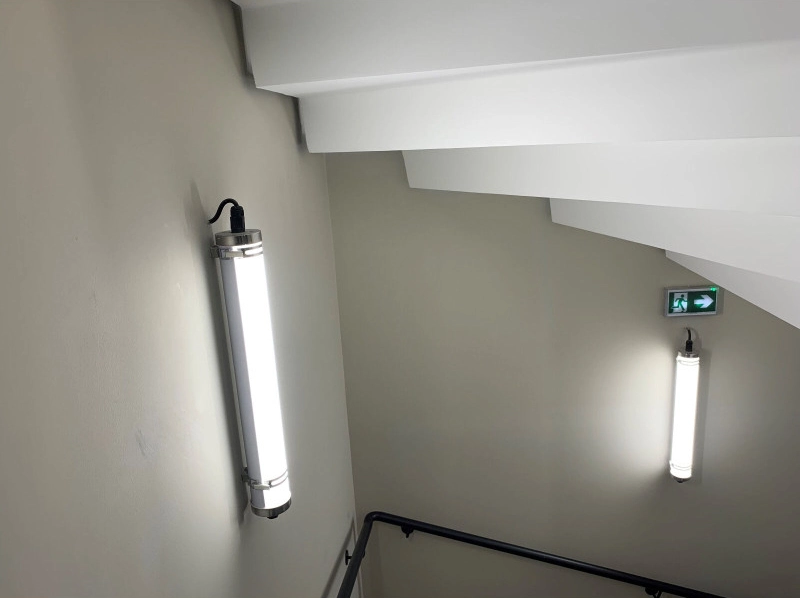
| Stairwell | 150-200 lux | Mandatory marking, BAES | Presence detection, standby 10% |
| Distribution corridor | 100-200 lux | Uniformity U0 > 0.4 | Presence detection per section |
| Underground car park | 75-150 lux (circulation), 300 lux (entrance) | EN 12464-1, mandatory BAES | Presence detection per aisle, standby 20% |
| Bicycle / pushchair storage | 100 lux | None (non-ERP) | Presence detection, full switch-off |
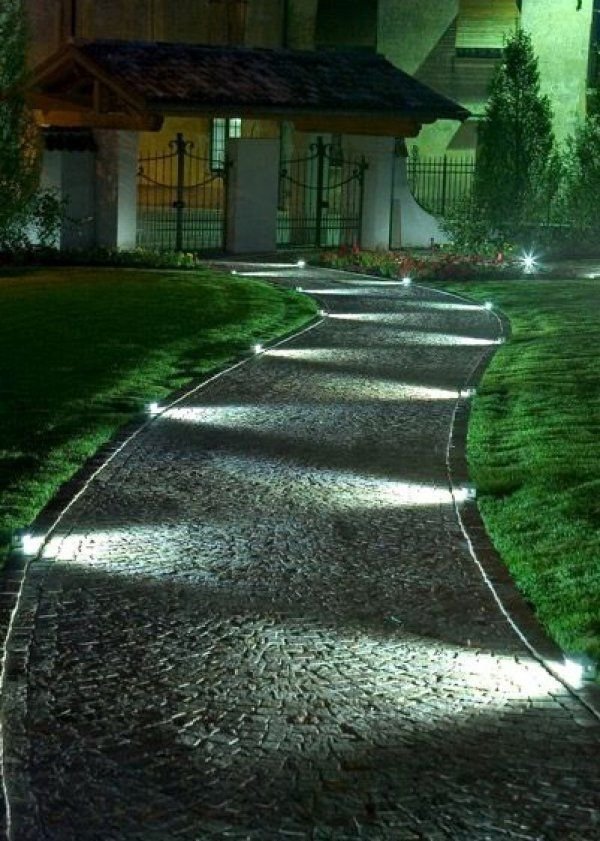
| Exterior / surroundings | 50-100 lux (pathways) | Min. IP65, anti-glare | Astronomical timer or detection |
Emergency lighting and BAES
Autonomous emergency lighting blocks (BAES) are mandatory in the common areas of certain co-owned buildings, particularly those classified as ERP or exceeding a certain number of dwellings. Rodalight integrates the verification of this compliance into every project and can replace existing BAES with long-life LED models, reducing maintenance call-outs.
- Standard BAES : 1 hour autonomy, minimum 45 lm flux in compliance with NF C 71-800
- LED BAES : lifespan of 8 to 10 years versus 3 to 4 years for fluorescent models
- Remote control system : centralised automatic testing, reduction of maintenance visits
- Evacuation marking : standardised pictograms, positioning according to evacuation plan
Convincing the general assembly
Lighting renovation in a co-owned building requires a vote at the AGM. To facilitate this step, we can produce a summary document comprising the inventory of the existing installation, the estimate of projected annual savings, the cost of works and the calculated return on investment. This document is designed to be presented directly at the assembly, without technical jargon.
Frequently asked questions
Does a vote at the AGM need to take place to change the common area lighting?
In Belgium, works on common areas generally require a decision at the general assembly. A like-for-like replacement (same location, same source type) may fall under day-to-day management depending on the co-ownership regulations. A full renovation project with new wiring or addition of detectors constitutes works and requires a vote. We help you qualify the nature of the works to prepare the right type of resolution.
Can the managing agent commission works directly without going through the co-ownership committee?
This depends on the amounts involved and the co-ownership regulations. In practice, we work with both the managing agent and the co-ownership committee, adapting our deliverables (quotation, technical file, AGM presentation) to the right point of contact according to the project.
Conclusion
Co-ownership lighting is a collective investment that is best assessed on a total cost basis over time: lower consumption, less maintenance, fewer breakdowns and an improved living environment for all residents. Rodalight supports managing agents from the audit phase through to works handover.
For associated car parking areas, our page residential car park lighting covers the specificities of these zones. For institutional or commercial buildings, see our page institutional lighting. To get started, our personalised study includes the inventory and savings estimate, or express advice for an initial orientation.