Colour rendering: the non-negotiable criterion in a butcher's shop
The colour rendering index (CRI) measures how faithfully a light source reproduces the tones of an illuminated object, on a scale of 0 to 100. In a butcher's shop, dropping below CRI 90 is a commercial mistake: meat takes on greyish or brownish tones that visually signal (wrongly) a lack of freshness.
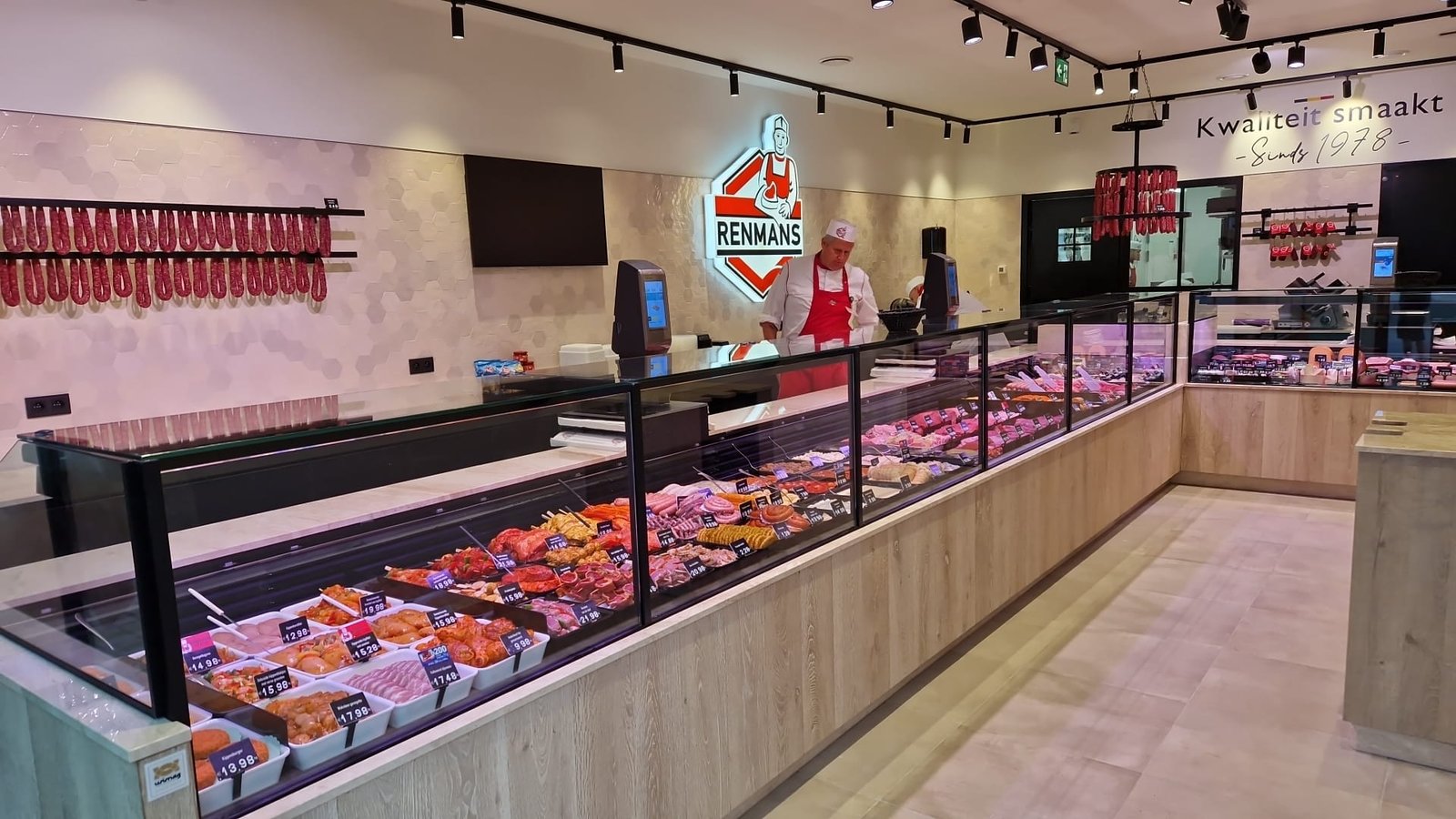
We work systematically with CRI 95 to 98 sources in display zones. At this level, the reds of beef, the pinks of pork and the whites of poultry are rendered with a precision that reassures the customer and showcases the product without artifice.
Colour temperature: between appetite appeal and realism
- 2700-3000 K : warm, enhances red and visual appetite appeal, recommended for display cases and counters
- 3500-4000 K : neutral, suited to preparation and laboratory zones, better visual acuity
- Above 4000 K : to be avoided on meat products, creates blue casts in tones and reduces appetite appeal

Technical requirements specific to the food sector
| Zone | Recommended illuminance | Min. CRI | Colour temperature | Specific requirement |
|---|---|---|---|---|
| Refrigerated display case | 500-1000 lux | CRI 95+ | 2700-3000 K | Low heat output, min. IP44 |
| Sales counter | 500-750 lux | CRI 95+ | 2700-3000 K | No customer glare (UGR < 19) |
| Cutting / preparation zone | 500-750 lux | CRI 90+ | 3500-4000 K | Washable surfaces, IP65, safety glass |
| Cold room | 200-300 lux | CRI 80+ | 4000 K | Temperature range -25 °C / +5 °C |
| General sales area | 300-500 lux | CRI 90+ | 3000 K | UGR < 22, consistency with display case |
| Facade / exterior window | According to exposure | CRI 80+ | 3000 K | IP65, resistance to high-pressure cleaning |
Hygiene and HACCP compliance
HACCP standards require easily cleanable surfaces and the absence of zones where residues can accumulate. The fittings selected for food zones meet several cumulative criteria.
- Minimum IP65 in preparation and laboratory zones, IP44 acceptable in closed display cases
- Safety protection glass (shatter-resistant) in zones in contact with food
- Sealed housings with no recesses or seals accessible to organic deposits
- Resistance to cleaning agents used in food hygiene (chlorine, acid)
- Controlled surface temperature to avoid creating hot spots above products

Return on investment and energy consumption
A butcher's shop operates 10 to 12 hours a day, 6 days a week. The lighting installation runs intensively, and switching to CRI 95+ LED sources generates substantial savings compared to halogens or fluorescent tubes still present in many food retail businesses. The return on investment is calculated over 2 to 4 years depending on the existing installation, with an LED lifespan of 50,000 hours.
Frequently asked questions
Can standard LED spots be used in a refrigerated display case?
No. Consumer-grade spots are not designed to operate in a cold and humid environment, and their heat output can destabilise the thermal regulation of the display case. We select specific low-heat sources, approved for use in refrigerated enclosures, with the appropriate IP ratings.
Does CRI 95 lighting consume more than a standard CRI 80?
Marginally. The difference in consumption between CRI 80 and CRI 95 on current LED sources is in the order of 10 to 15% for comparable luminous efficacy. This additional cost is largely offset by the direct commercial impact on product showcasing.
Conclusion
Butcher's shop lighting is as much a commercial investment as a technical requirement. Well designed, it showcases every product in the display case, reassures the customer about freshness and differentiates your business from supermarket competitors. Poorly designed, it becomes a barrier to sales that neither product quality nor the butcher's craft can compensate for.
For food retailers with mixed presentation, our pages bakery lighting and organic shop lighting cover related challenges. To scope your project with a specialist, start with our personalised study or express advice.