
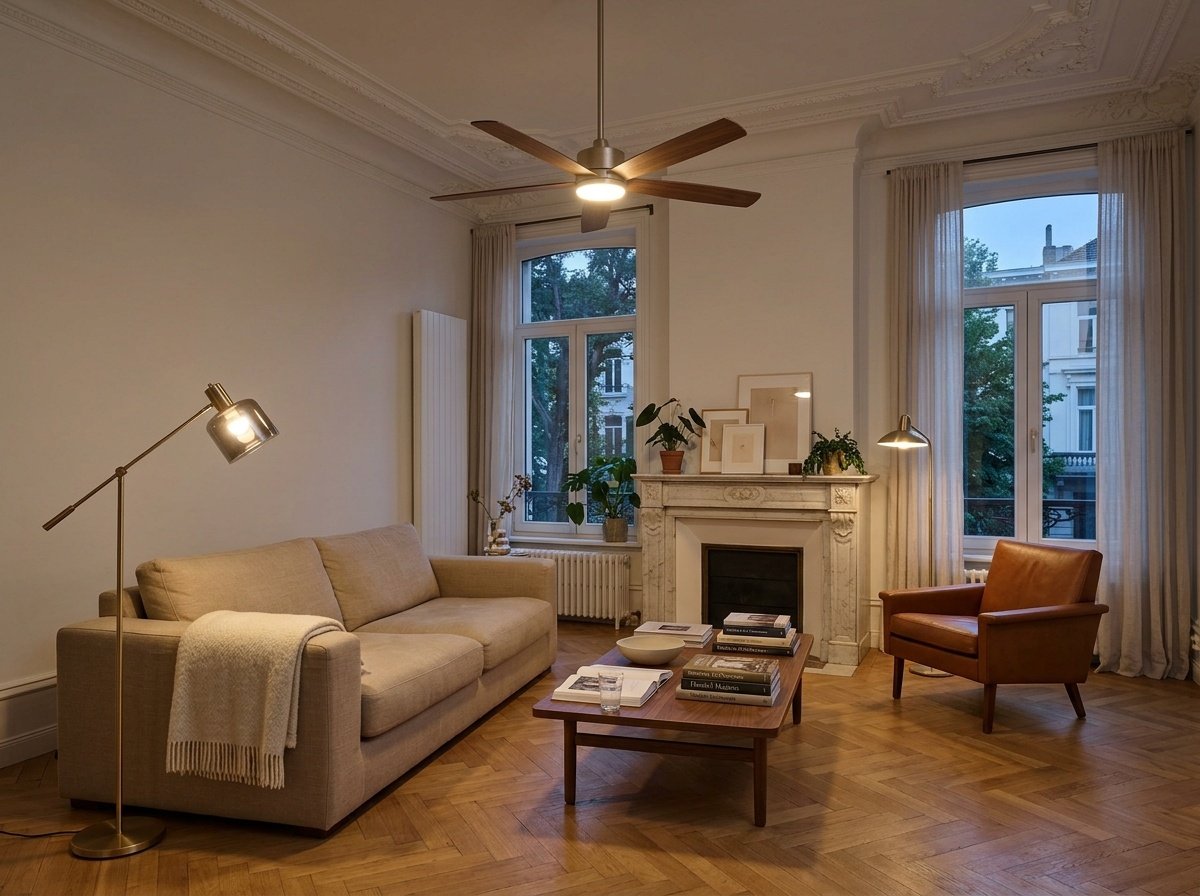
The ceiling fan is making a striking comeback in homes, driven by hotter summers and models that are far more stylish than they were ten years ago. Light-coloured wood, slender blades, a quiet motor, and often integrated LED lighting in the centre. On paper, it’s the ideal solution: a single fixture on the ceiling serving two purposes. In practice, the result depends on a few choices that are rarely made at the right time.
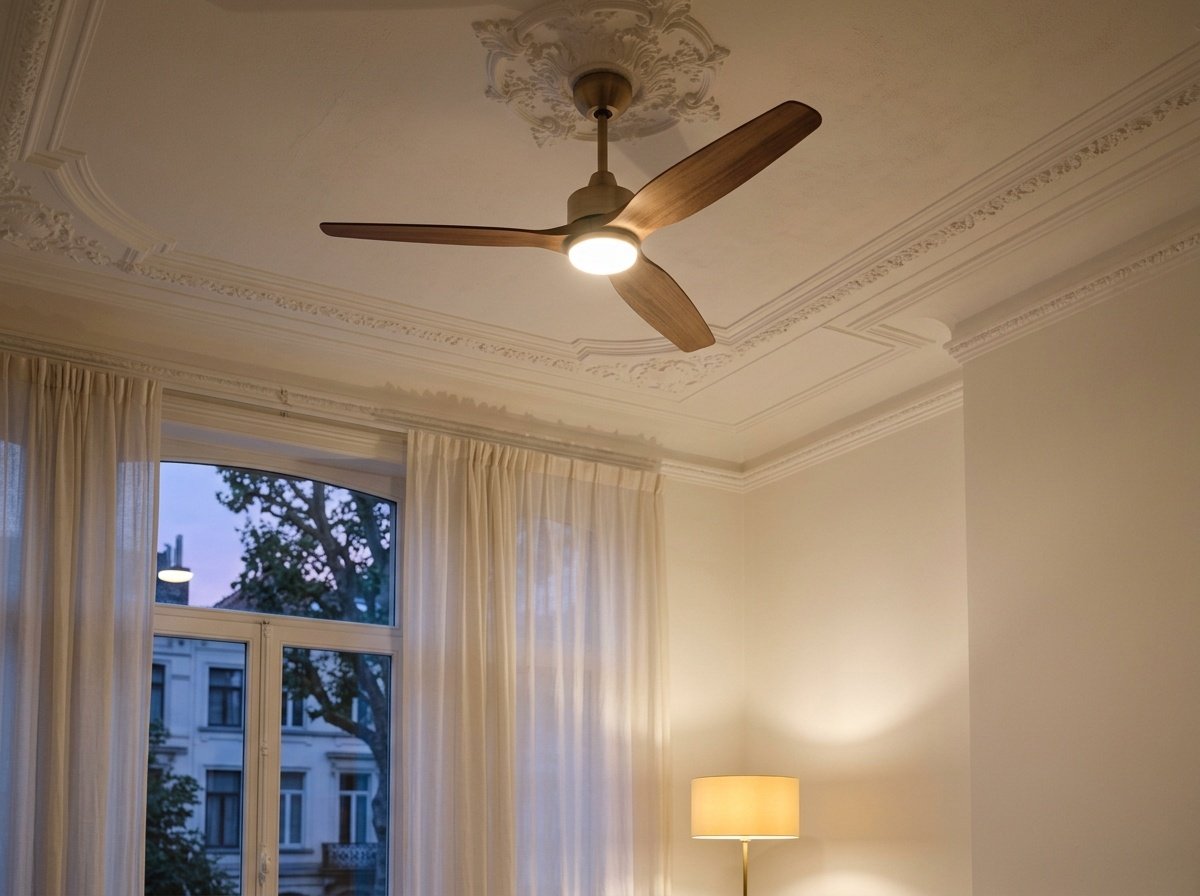
Why this resurgence?
- A low-energy alternative to air conditioning: a fan uses a fraction of the energy of an air conditioner, and is often enough to keep a room comfortable during heatwaves.
- Suitable for year-round use: most recent models are reversible. In winter, when running at low speed, they direct the warm air that has built up beneath the ceiling downwards.
- Quieter DC motors: DC motors are quieter and more energy-efficient than older AC motors, and offer a wider range of speeds.
- Design has become decorative: the fan is no longer something to be hidden away; it has become a piece of furniture in its own right.
The pitfall: relying on it to light up the whole room
This is the most common mistake. A light fitted to a fan is simply a central light source, nothing more. It provides general lighting – often rather flat – which illuminates the centre of the room well but the walls and corners much less so.
In a living room or bedroom, this unique ceiling light creates exactly the sort of atmosphere one is trying to avoid: uniform, flat lighting, with dark patches where one reads or works. A lighted ceiling fan works well as a basic light source, provided it is supplemented by task lighting, wall lights or accent lighting.
Things to check before buying
The quality of the integrated lighting
On many models, the LED module is a secondary accessory, and its quality suffers as a result. As a minimum, check the following:
- The CRI (Colour Rendering Index): aim for 90 or above for a living room, 80 as an absolute minimum.
- Colour temperature: 2700K to 3000K for a cosy atmosphere. Models with adjustable colour temperature are handy, but do check that they really do go down to warm white. Our article on choosing the shade of white goes into more detail on this point.
- Dimming: a central light that cannot be dimmed is rarely pleasant in the evening.
- Replacement: a built-in, non-replaceable LED module means that, in the event of a fault, the whole unit may need to be replaced. A standard socket or a removable module is more durable.
The right diameter for the part
| Area of the room | Approximate diameter | Note |
|---|---|---|
| Less than 10 m² | 75 to 90 cm | Children’s bedroom, study, small bedroom |
| 10 to 20 m² | 105 to 120 cm | Master bedroom, dining room |
| 20 to 30 m² | 130 to 140 cm | Standard stay |
| Over 30 m² | 150 cm and over | Or two fans for a large open space |
These guidelines vary depending on the manufacturer and the ceiling height. A fan that is too large for a small room can feel overwhelming, whilst a model that is too small will have to run at a higher speed – and therefore more powerfully.
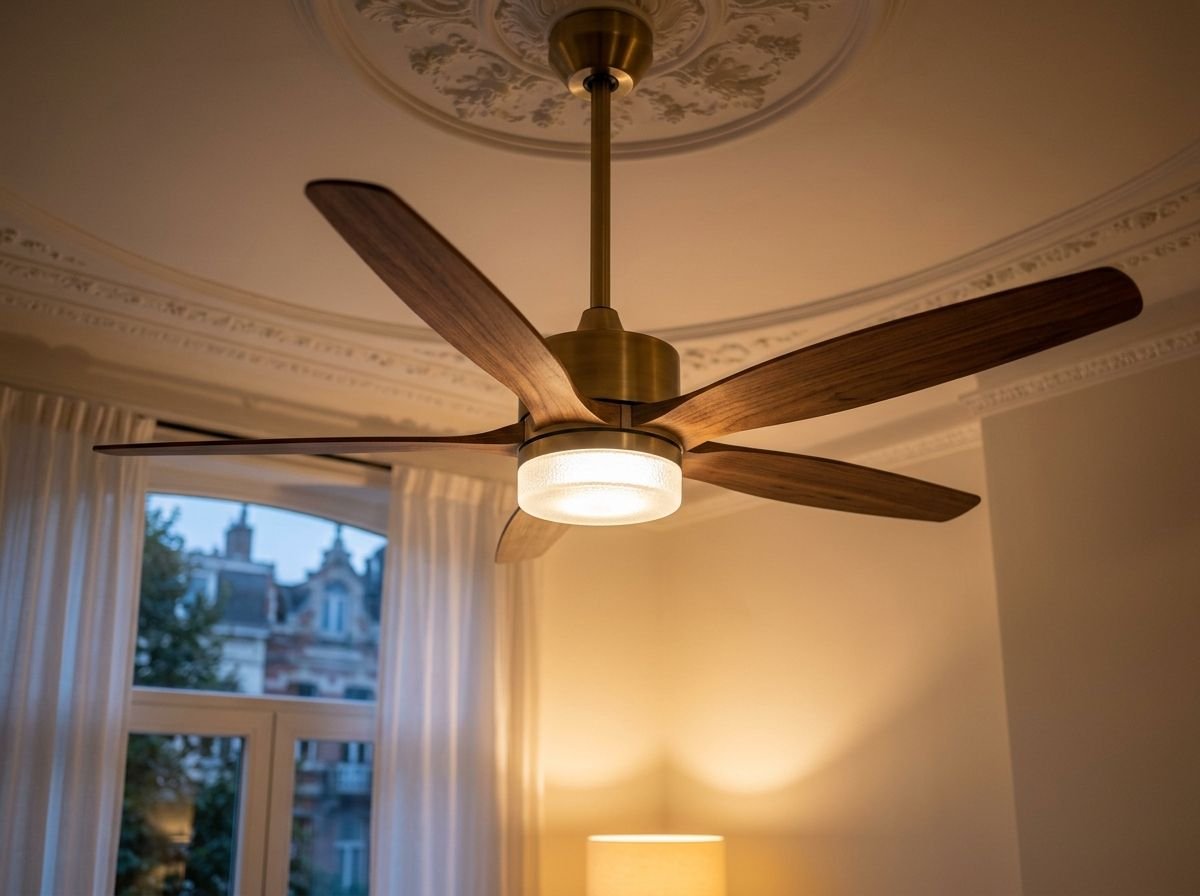
Height and installation
- Blade height: approximately 2.30 m above ground level is a good guideline, and never less than 2.10 m for safety reasons.
- Mounting: A fan vibrates and is heavier than a ceiling light. It must be mounted on a suitable bracket, not simply on a junction box.
- Separate controls: make sure you can control the lighting and ventilation independently. Being able to switch on the light without turning on the fan is a convenience you’ll soon come to appreciate.
- Dimmer: never connect a standard dimmer to a fan’s circuit. The motor is not designed for this; please use the remote control or the module supplied.
Beware of the stroboscopic effect
One detail that is often only realised too late: if spotlights or other light fittings are positioned above or next to the blades, the blades block the light as they turn. The result is a flickering pattern of shadows on the ceiling and walls, which becomes very unpleasant over time. When planning the layout, it is therefore important to consider the fan and other light sources together, and to position the spotlights away from the area swept by the blades.
And in a shop or a restaurant?
Ceiling fans also have their place in a café, a covered terrace or a shop with a natural style. In these settings, the rule is the same but the stakes are higher: built-in lighting is rarely sufficient on its own to showcase a product or a room. It must form part of an overall lighting plan, designed specifically for the restaurant or retail outlet in question.
Conclusion
A fan with a built-in light is an excellent idea, provided you see it for what it is: basic lighting, not a complete lighting scheme. Choose a high-quality LED module, ensure the unit is the right size, be aware of the stroboscopic effect, and supplement it with additional light sources. For a house or flat, a 20-minute Quick Consultation is often enough to confirm the layout before you buy.