
Regulations governing the illumination of business premises
The rules governing lighting in the workplace are set out in standard NBN EN 12464-1. Every employer must comply with them to ensure the safety of their employees: optimum lighting helps them to spot obstacles and avoid them.
Good to know: this standard also applies to lighting in schools, and specifically in school classrooms where pupils must not suffer from a lack of light either. The quality of the surrounding light is essential for the comfort of students, especially at desk level where they are studying or working. This standard requires what is known as an illuminance level of 500 lx (read lux) to be provided in this area.
Sufficient light will also provide them with good visual comfort so that they don’t tire their eyes. It will also enable them to carry out their tasks with precision. It has a major influence on the atmosphere in offices, meeting rooms, classrooms and open spaces.

Optimising office lighting
Every work surface needs to be well lit to maintain the employee’s visual acuity. It is also thanks to good lighting that contrasts and relief can be perceived perfectly. The notion of illuminance is therefore important in defining the amount of light to be diffused on each surface.
On sunny days, for example, this light intensity can reach up to 10,000 lux. Of course, you won’t need this level of intensity in an office or other workspace. Here are some examples of ideal values for each zone:
- between 500 and 700 lux for a computer workstation
- 1,000 lux for any assembly area where a certain degree of precision is required
- 500 lux for laboratory benches
Illumination of 100 lux is sufficient for high-traffic areas such as corridors and staircases. The amount of light must be carefully controlled, as under-lighting can cause stress and make users feel uncomfortable, while over-lighting can cause glare.
Good colour rendition also plays a part in the visual comfort of the worker. In offices, the standard is for the colour rendering index to be as close as possible to 100, which is the maximum value.
Glare and the concept of UGR
What is the UGR?
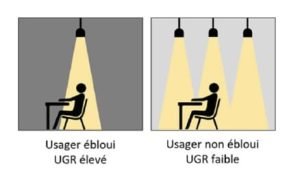
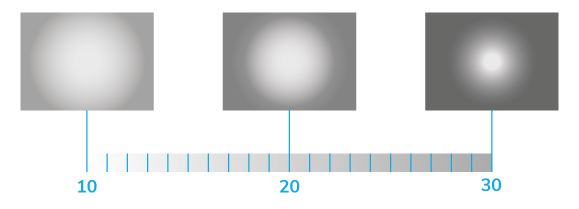
The UGR (Unified Glare Rating) is a method used to assess the degree of glare for the user. It is a CIE 117-1995 formula that calculates a glare level for a given type of luminaire in a given environment. The calculation compares the luminance contrast between the environment and the luminaires: the greater the contrast, the more the user is dazzled and therefore the higher the UGR.
The UGR is therefore a concept related to the environment in which the luminaire is installed.
Example 1 A user will be more dazzled if they are in a dark room with a single luminaire than if the light is more evenly distributed.
Example 2 For two rooms with identical dimensions and luminaire layout, the UGR will be higher if the walls are black than if the walls are white.
The UGR in practice for your lighting projects
Case 1: Choice of luminaire on the basis of its technical data sheet
All RODALIGHT data sheets show a comparative UGR. This means you can select the right luminaire for your project directly from its data sheet.
Case 2: Choice of luminaire based on a DIALUX study
Do not hesitate to contact RODALIGHT if you would like a DIALUX study, which will enable you to check the UGR at all the points requested.
| UGR value | Use / type of part |
| UGR < 13 | Negligible glare |
| UGR < 16 | Technical drawing, precision work, treatment room |
| UGR < 19 | Offices, general working environment |
| UGR < 22 | Crafts, canteen, rest room |
| UGR < 25 | Cloakroom, bathroom, machine room |
| UGR < 28 | Docks, traffic areas, corridors |
Favour natural light
Ideally, daylight should be preferred in every working environment, because it gives employees more energy and supports their productivity. Studies have also shown that daylight promotes energy and concentration.
It should be noted, however, that natural light fluctuates throughout the day and with the seasons. It is therefore essential to combine it with artificial lighting.
Choosing the right colour temperature
Colour temperature affects the atmosphere in an office or on an open stage.
Neutral white light
Neutral white light, with a temperature of between 4000°K and 4500°K, gives a cool, light white light. Some people will find that this shade reproduces natural light. Others, however, will find that 6000°K is more like natural light. Still others will find that 6000°K is more like daylight with a hint of blue.
It’s important to understand that in these perceptions, nobody is wrong! Everyone has their own perception. That’s why RODALIGHT is here to help you see, choose and define the colour temperature that suits you best. This is made possible by a wide range of test equipment that helps you to see what light really looks like.
Warm white
Warm white (whose temperature varies between 2000°K and 2700°K or even 3000°K) has yellow-orange reflections. It is mainly used to create a friendly atmosphere in small offices and wellness areas. Daylight white (from 5000 K to 6500k ) is characterised by its bluish reflections.
A workstation requiring an illuminance of 500 lux could be lit by a lamp emitting a light warm white (3000k) or neutral white (4000k). There is no best shade, so it will be a more personal choice. We’ll help you make the best decision. A neutral or cool light can also be used in a large room requiring powerful lighting, such as a laboratory or warehouse.
Combining direct and indirect light sources
Indirect lighting is provided by ceiling and pendant lights. Its purpose is to diffuse an overall, uniform light into a room. It eliminates shadows and produces no glare. Its brightness should enable you to read your documents, work on a screen and move around comfortably. By opting for dimmable lamps, you can intensify or reduce their brightness according to your needs.
Direct light is directed at a specific object or location. It can be produced by auxiliary lighting such as a desk lamp or jeweller’s lamp. It allows details to be clearly distinguished, making it easier to work.
As a general rule, direct light will make up 10-20% of the lighting atmosphere in an office, compared with 80-90% for indirect light.
Luminaires to use
Creating a good lighting system depends on a number of factors, including :
- the colour of the walls
- the surface to be lit
- the furniture
These criteria, together with the interior design of your workspace, will help you choose the right light fittings. These will be both functional and aesthetically pleasing, and can be installed :
- LED ceiling lights and panel tiles
- recessed Led spotlights
- wall lights
- floor lamps
In conclusion, there are many parameters involved in designing an effective lighting system to support worker performance and satisfaction. A specialist like Rodalight will assess the light reflection coefficient of walls, bay windows and furniture, study the orientation of rooms and determine the tasks to be carried out accordingly.