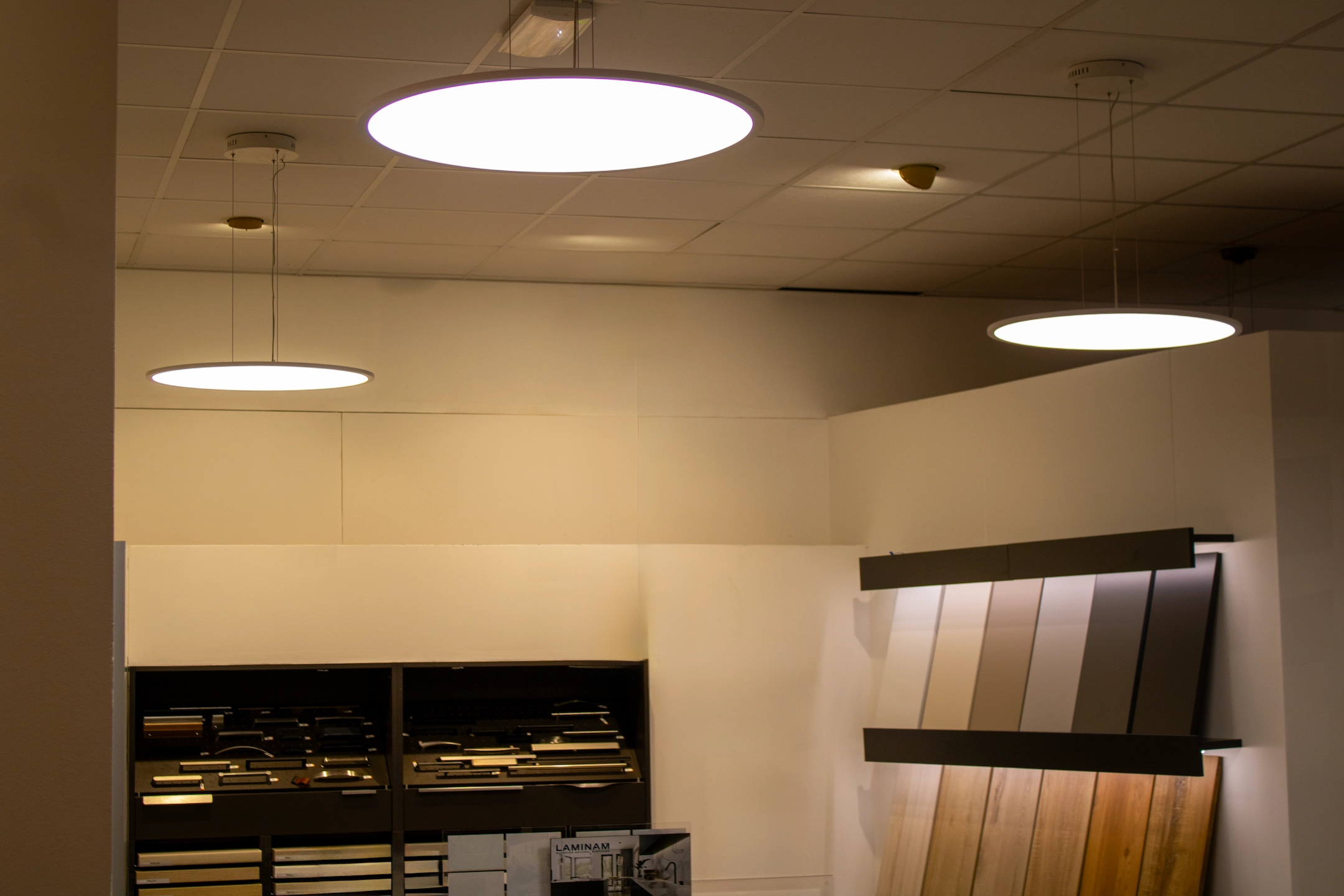

LED relamping is a simple but strategic approach: it involves replacing existing light sources – halogen, compact fluorescent or neon tubes – with modern LED lamps. The result is an immediate improvement in lighting performance and substantial energy savings. For businesses and private individuals alike, relamping is a practical way of reducing energy costs and improving lighting quality.
What is LED relamping?
Relamping means replacing existing bulbs or luminaires with newer, more efficient models. With the advent of LED technology, this operation has taken on a new dimension. LEDs consume up to 90% less energy than a halogen or incandescent bulb, for an equivalent or even higher level of illumination.
There are two approaches to relamping:
- Simple relamping: direct replacement of bulbs with compatible LED equivalents (same base, same voltage).
- Complete relamping: modernisation of the entire luminaire, often necessary for old fluorescent tubes or professional installations.
In both cases, the result is the same: immediate energy savings and greater durability for the lighting system.

Measurable energy savings
Thanks to their high light output (up to 120 lm/W), LEDs efficiently convert electricity into light. A 10 W LED bulb can produce as much light as a 60 W halogen bulb. Over time, this difference translates into significantly lower electricity bills.
Here’s a concrete example:
- Halogen 60 W – average life: 2,000 h – annual consumption ≈ 88 kWh
- LED 10 W – average life: 25,000 h – annual consumption ≈ 15 kWh
- Savings: 73 kWh/year per light point, i.e. around €15 (based on €0.20/kWh)
On a building equipped with 50 luminaires, the annual saving can therefore exceed €700, for an investment that pays for itself in just a few months.
Less maintenance, more comfort
LED lamps have an average life of 25,000 to 50,000 hours, up to ten times longer than conventional technologies. This considerably reduces replacement and maintenance costs, a major advantage in professional or public spaces.
Another advantage is that LEDs produce more stable, flicker-free light, with a choice of colour temperatures to suit each environment – from warm white for reception areas to neutral white for workstations.
Luminaires with replaceable bulbs or luminaires with integrated LED modules?
LED relamping is now moving towards full LED luminaires with integrated COB modules, because they offer much better performance than luminaires with replaceable bulbs. These luminaires guarantee a stable luminous flux, greater energy efficiency and even distribution with no shadows. Their compact design also provides a more elegant appearance and optimum thermal control, extending the life of the LED module. Unlike older bulb-based solutions, which are often less efficient and consume less energy, integrated LED luminaires provide better quality, longer-lasting lighting that is truly adapted to today’s requirements.
A positive impact on overall energy performance
By lowering electricity consumption, LED relamping contributes directly to reducing the building’s carbon footprint. This optimisation is fully in line with the CSR and energy efficiency strategies pursued by companies.
What’s more, a number of grants and subsidies may be available to support the switch to LEDs, particularly in the context of energy renovation.
How can LED relamping be a success?
The success of a relamping project depends on a precise analysis of lighting requirements and technical constraints:
- Identifying areas with high savings potential (communal areas, workshops, car parks, shop windows, etc.)
- Choose quality LED products with a good colour rendering index (CRI > 80)
- Adapt colour temperatures according to use (2700 K to 6500 K)
- Choose luminaires that are compatible with dimming or presence sensors
- Call in a professional for sizing and electrical compliance.
Relamping, a simple and cost-effective transition
Unlike other renovation projects, relamping is a quick and non-intrusive operation. It does not require any major works or business interruptions. In most cases, the new luminaires fit in perfectly with the existing installations.
Once the transition has been made, the benefits are immediate: reduced consumption, improved lighting and a rapid return on investment.
An economical and ecological choice
As well as saving energy, LED relamping is part of the transition to more sustainable lighting. Mercury-free, recyclable and with low heat emissions, LEDs are the solution of the future for reconciling performance and environmental responsibility.
So by opting for LED relamping, you’re doing something that’s good for your budget and good for the planet.
In a nutshell
- Up to 90% energy savings
- Lifespan of up to 50,000 hours
- Less maintenance and waste
- Rapid return on investment
- Improved comfort and light quality
LED relamping is the simplest, most effective and most profitable solution for reducing energy consumption in buildings. It’s a cost-effective, environmentally-friendly and sustainable operation.